
#100meters – The Staff.#100meters documents a one hundred meter stretch of road and the life that unfolds within that space.
My one hundred meter location is on Lazimpat Road, Kathmandu.
#100meters – The Staff.#100meters documents a one hundred meter stretch of road and the life that unfolds within that space.
My one hundred meter location is on Lazimpat Road, Kathmandu.
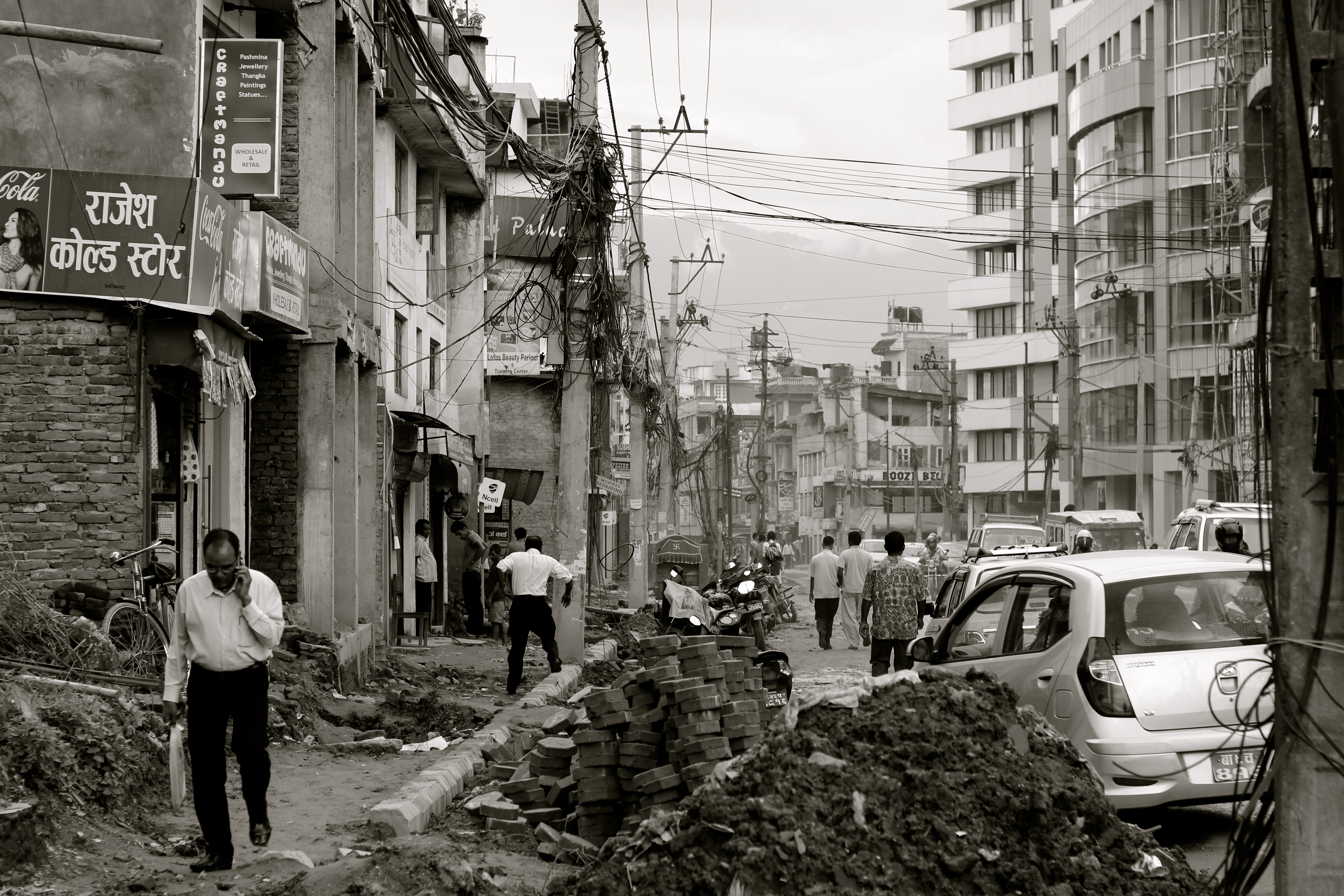 #100meters documents a one hundred meter stretch of road and the life that unfolds within that space.My one hundred meter location is on Lazimpat Road, Kathmandu.
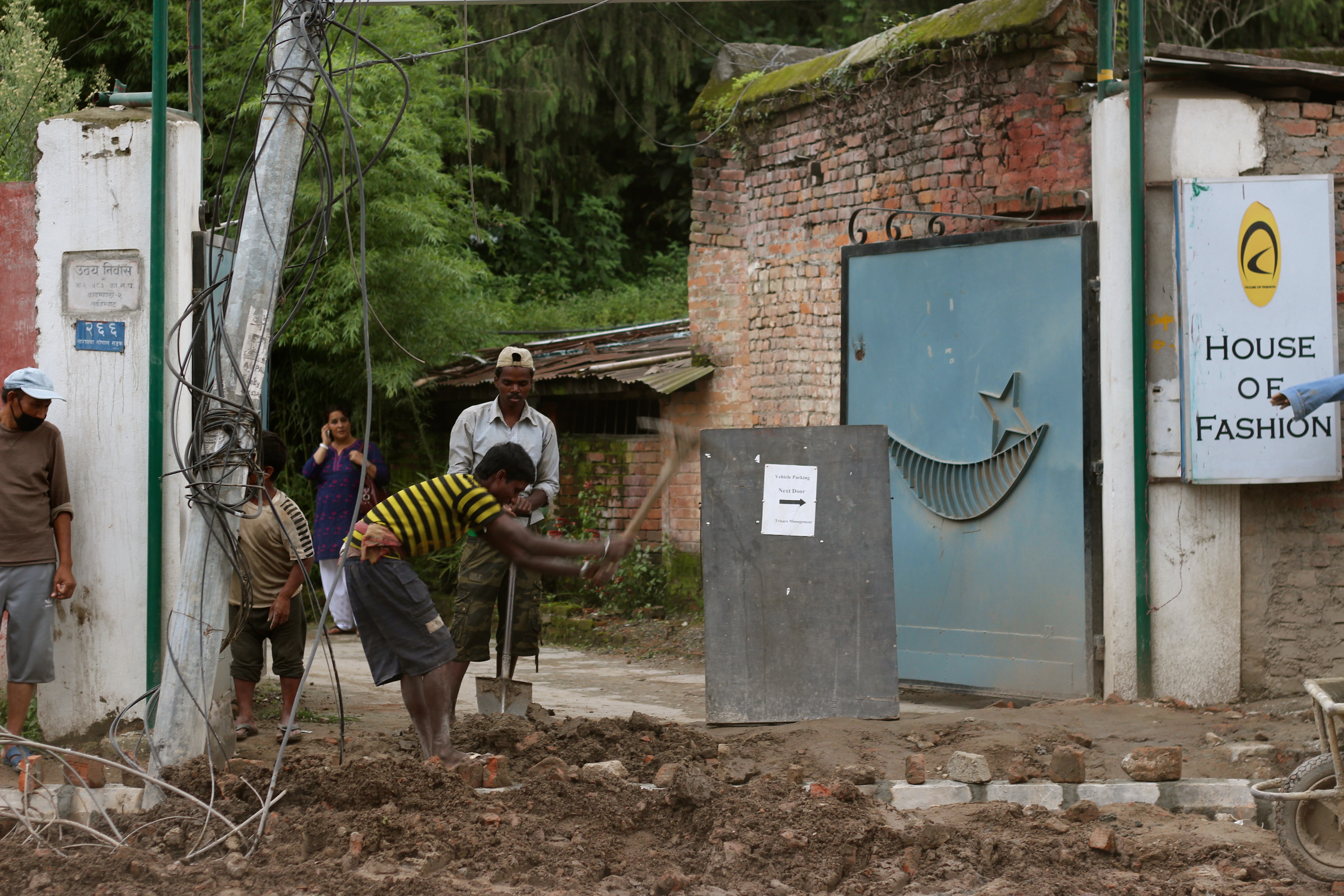

The road widening of Lazimpat Road, a pivotal commuting route of about 10 kilometers in Kathmandu, so far has taken 18 months and the project is nowhere near completed.
Locals deal daily with mud,power and telephone wires fallen over the street and sidewalk, huge holes into the sewerage system. Locals and expats have fallen into the sewers and open manholes during various stages of the road upgrade.
One expat fell in after new year’s celebrations and was up to her neck in shit going the stories circulating about the incident. A local woman is known to have fallen down an electrics access hole while walking her son home from school. Allegedly her leg snapped as her momentum into the shallow hole carried her forward.
The road widening and improvements will be of significant benefit once completed but shop owners and others spoken to along the road express a resigned frustration.
“It is very bad for business, but this is how it is for now.”
Sidewalks are now being laid in sections, which is improving things significantly for walkers and businesses.

#100meters documents a one hundred meter stretch of road and the life that unfolds within that space.
My new one hundred meter location is on Lazimpat Road, Kathmandu.
The “how to” rumours of dealing with the Nepali banking system vary from the typical red tape jumping of life to the downright ridiculous.
To get a Student Visa in Nepal you need to get a bank account, to get a bank account as a foreigner with Bank One you need a Student Visa or other resident visa status. Having a local guarantor makes no difference to the head of Customer Relations. Having documentation from your Government saying you have permission study doesn’t matter an iota. Explaining the contradictory manner of their policy which stops them having more foreign customers who want to bank with them, she gives not one tot.”No, it doesn’t and will not effect our business.”
A tautological discussion of this nature goes on for around 20 to 30 minutes. And after queuing for a good 30 minutes before this the woman is done. She kindly asks the Head Customer Service Officer one last time if there is a possible solution. “Yes, go, go to another Bank.”
The woman does. On the suggestion of another ex-pat the woman visit’s Bank Two and within 20 minutes has a bank account, a laugh with the staff taking her through the process and an assurance she will be looked after as other friends have said though they are a new bank they are okay.
All up just over two hours to open a bank account isn’t bad, actually it is down right good, but that conversation of circles with the Head of Customer Relations is telling of something amiss here.
But the woman doesn’t care, she has her bank account and is a step further in getting her visa to study arts for a few months. Leaving Bank Two she quietly wanders down the splashy humid streets to rejoin her companion.
As Geo-politics are played out across the globe it becomes clearer the acts of the powers that be are moving us closer to a global crisis of some description or another. Be it intentionally blocking progress in international relations to meet niche short term goals around nuclear issues or denying the need to address our dependence on fossil fuels.
Noam Chomsky’s Are we on the verge of self destruction? eloquently states the status quo – one that the world actively endeavors too close its eyes to. The consequences of this are potentially disastrous.
For the first time in the history of the human species, we have clearly developed the capacity to destroy ourselves.
What is the future likely to bring? A reasonable stance might be to try to look at the human species from the outside. So imagine that you’re an extraterrestrial observer who is trying to figure out what’s happening here or, for that matter, imagine you’re an historian 100 years from now — assuming there are any historians 100 years from now, which is not obvious — and you’re looking back at what’s happening today. You’d see something quite remarkable.
For the first time in the history of the human species, we have clearly developed the capacity to destroy ourselves. That’s been true since 1945. It’s now being finally recognized that there are more long-term processes like environmental destruction leading in the same direction, maybe not to total destruction, but at least to the destruction of the capacity for a decent existence.
And there are other dangers like pandemics, which have to do with globalization and interaction. So there are processes underway and institutions right in place, like nuclear weapons systems, which could lead to a serious blow to, or maybe the termination of, an organized existence
There have been a range of reactions. There are those who are trying hard to do something about these threats, and others who are acting to escalate them. If you look at who they are, this future historian or extraterrestrial observer would see something strange indeed. Trying to mitigate or overcome these threats are the least developed societies, the indigenous populations, or the remnants of them, tribal societies and first nations in Canada.
The rest of the article can be read on Banoosh.
The price we pay for ignoring the reality we live in and continuing to allow corporatist and limited Geo-political interests run our world is our demise. We have a responsibility to not only educate ourselves about this, but to act. We must act before it is too late.
As a woman there are reports and articles I should just stop reading. The majority of main stream media with its casual gendered slant would be a good start.
Since the beginning of this year, New Matilda, an independent Australian online media outlet, has been researching various aspects of gender representation in Australia’s MSM with their Women in Media study.
The results have been from the obvious to the depressing.Coinciding with the “normal” dismissive arguments or the twisting of findings, if the outcomes do not fit the convenient operating models of the industry and wider society and culture around women. Essentially though women are more represented across the medium they are still under represented in bylines, as sources, as primary content and in the upper echelons of the industry. And as the media is the filter through which society views itself this has a knock on effect to how women are perceived and valued.
What is particularly depressing about the whole thing is the attacks work like this comes under. It is unfortunately normal when women or anyone dares to speak out to the on-going and systematic imbalance women face in daily life and how they are represented. Fairfax’s Clementine Ford aptly summed up the situation in her Daily Life piece ” It’s considered a weakness to be a woman in Australia”
The battle for liberation is apparently the last refuge for women unable to participate in an economy that places their sexual availability at a premium. Having someone want to fu*k you is evidently more of an aspiration than wanting them to see you as an equal human being in your own right, with opinions and thoughts worthy of consideration and an autonomy that is yours and yours alone.
But this merely symptomatic of a larger war against women in the developed world. Rights over women’s bodies and what happens within them are being systematically eroded. Our bodies our health and how we want to live our lives is surely our own decision? But if legislation such as what passed in Texas today becomes more normalised ,the legislation basically shuts down legal abortion clinics within the state and severely restricts access to abortion no matter what the circumstances, we women are in trouble.
We may have a perceived sexual freedom but it is not true freedom, we do not have equal representation, equal pay (Pay gaps between men in women are Australia are actually increasing and sits between 17 and 25 percent depending on where you live), equal support systems and we are always negotiating our lives through the male objectified gaze or how we are in relation to men’s wants, desires and power structures.
You are “equal” as a woman if you are slim, sexualised, live within the construct of what a woman should be rather than is, are prepared to earn less , let others make the decisions about your body and what you are allowed to do with it, and learn to live with the subtle pervasive sexism inherent in daily life as a woman.
The Everyday Sexism Project has powerfully documented what the female sex live with through collecting the story of everyday incidents women experience around gender.
Obviously this is a very nuanced and complex issue and the above are general indicators of a growing trend of increasing issues for women legally and otherwise. Progress was made but now with terms like feminist becoming increasingly disparaged or distanced from,where are we heading?
Is there anyway to have a rational discussion about the inequities of this without being gaslighted or being told to get over it? How do we address and change our gendered interactions without further harm?
Or is it time to give up, put on the blinkers, shut the ears, climb into the imposed box, and stop reading the news and live life knowing these are the limitations. Living these imposed limitations not from a place of victim-hood but of acceptance. This is how it is, it is getting worse in many subtle aspects…. or is it we are just starting to talk about how fed up we are with pseudo equality, an equality that does not exist in real life?
My coverage of the Red Bull X-Alps 2013 press conference for Sano Babu Sunuwar, National Geographic’s Adventurer of the year 2012, who is about to under take the extreme multi-sport adventure across Europe for the first time.
Link here.
From Pokhara, Nepal ,Babu leaves for Europe later this month. You can support his Red Bull X-Alps funding campaign at GoGetFunding.com
A few months ago I wrote a piece here about my growing frustration at rape terminology being used as part of the American election campaign. The piece also touched on the general slippage occurring around gender issues. Or perhaps in a more nuanced explanation, how there seems to be a reluctance to engage with the gender issues that still remain in our society and culture.
This reluctance ranges from dismissal or that old classic in gender debates; a twisting of everything to make those speaking out about discrimination etc dance to prove the negative. And when you do, this is dismissed or an excuse is found not to engage with the evidence presented. When these people are challenged to prove gender equality, equal representation, the twisting becomes more profound and in many occasions the debate then becomes personal.
A few days ago I posted Clementine Ford’s International Women’s Day article Are Women’s Voices being Gagged to a New Zealand journalism Facebook forum Kiwi Journalist’s Association (KJA).
Essentially Ford argues the following;
“If the media is a portal through which we see the world, how does the conspicuous absence of women and their voices skew how people experience the world around them? Across the board, the facts show that women are significantly absent from that mirror the media reflects back onto society. Women operating in the public space are constantly reminded that their presence is a privilege, not a right – and that privilege can be taken away any time they break the rules.”
My reason for posting an Australian Fairfax created article in an NZ journalism forum was two-fold. One, the NZ media does not work in blessed isolation despite some of the protestations of those who objected to the article ( Fairfax owns a large percentage of the NZ media market), it’s posting and my defense of it. Secondly, the content of Ford’s piece is indicative of some of my experiences working in NZ media until I left the country in 2010 and I strongly believe illustrates the boy’s club type structure the media generally speaking operates from.
To clarify, my posting of the article wasn’t denying progress around gender issues but it was a statement that there are still considerable issues around gender that the media industry in NZ has an obligation to address.
In some ways a majority of the reaction to my posting of the story is indicative of what I feel is the boy’s club mentality in action. That I should be grateful for what I have and to raise my head above the parapet and question the status quo isn’t the done thing. I am aware of the ramifications of speaking out and continuing to do so. There is an implicit risk to speaking on gender issues; I will be labelled as difficult and I feel there are possible career implications.
In the discussion I was constantly asked to prove the inequality, which I along with a few other brave women journalists did. These studies were predominantly international and therefore were declared invalid by those protesting against Ford and our support of her argument. When NZ studies were produced these were also largely dismissed and then the statistics of the Massey University study were used as a justification for why there would not be parity and gender equally in NZ media for about 30 years ” because of the statistics.” When I asked, repeatedly for evidence of the gender equity and pay parity in NZ media none was offered and, in what I feel was a rather patronising tone, I was told I didn’t understand the argument.
I would like to post the thread in its entirety here but the KJA Facebook group is closed and by invitation only. Out of respect for my colleagues and the group I will not post screeshots nor I will identify those who were particularly unhappy with my call for proof of equity in the NZ media industry. That said the administrators ironically proved Ford’s argument by closing the thread and “gagged” the female voices speaking out with evidence and experiential knowledge of how the NZ media can work for women.
I admit I hold KJA in far lesser regard due to the exchanges that took place in the forum and their lack of framework around gender issues that daily effect a large number of their membership. It also, from my perspective, speaks to the state of the industry that very few women spoke out about their concerns in an open forum and some male journalists felt free to behave in an unprofessional and sometimes bullying manner.
A number of women did contact me privately and thanked me for speaking up and for confirming that they weren’t “going insane”. To those women, thank you for your support, it was an unpleasant run in which ultimately proved Ford right – I am appreciative of that. The article is not as one person stated “facts obscured by emotive, partisan twaddle.”
Here are some further links speaking to the issues and general position of women in media. Please note all of these links were used in the KJA discussion thread.
http://www.knightfoundation.org/grants/20120284/
http://changetheratio.tumblr.com/
http://www.scoop.co.nz/stories/BU1112/S00093/women-journalists-flee-newspaper-careers.htm
http://journalistcomplaints.com/article/2012/07/meaa-needs-act-gender-bias-newsrooms
http://www.theaustralian.com.au/media/how-women-journos-stake-place/story-e6frg996-1225713076068
 The Storyteller Project