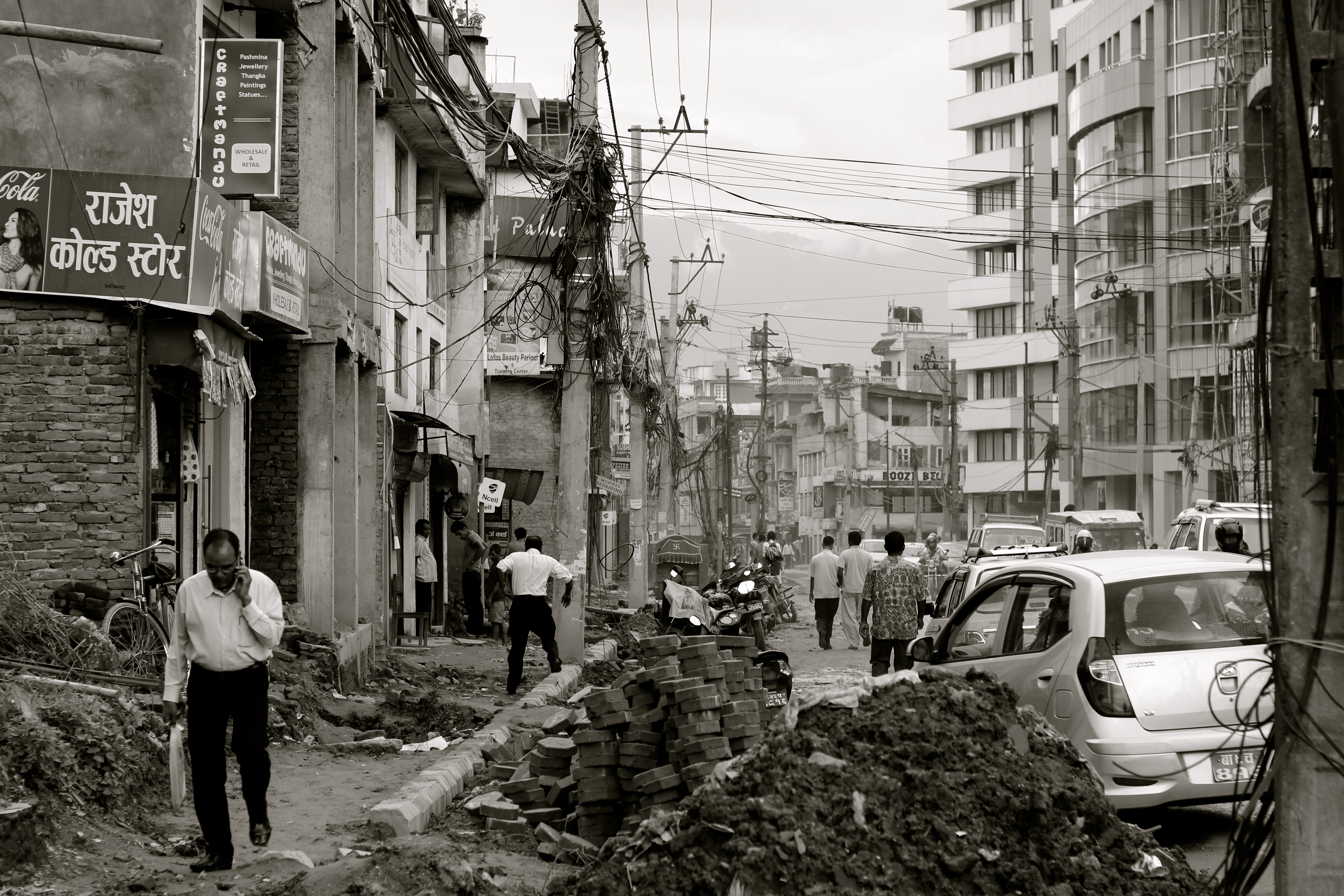
 #100meters documents a one hundred meter stretch of road and the life that unfolds within that space.My one hundred meter location is on Lazimpat Road, Kathmandu.
Development
Living on the moon – Melbourne vs Kathmandu.
Arriving in Australia to live ( abet temporarily) in one of the country’s most affluent suburbs after four months in Nepal is like moving to the moon.
In Toorak, one of the most wealthy suburbs of Melbourne ,Australian Tax Office figures (2010) indicate the average annual income hovers around $132252. In Nepal the average income, according to World Vision, sits around $200. Rather astounding that on average one Toorak resident earns the same as 661 Nepali’s. This coincides with a huge disparity in population density. In Kathmandu 13,225 people live per square kilometer, urban Melbourne is light weight in comparison with 2010 Australian Bureau of Statistics figures placing population density at 530.
But this is nothing if you look at quality of life, various pollution indicators, working conditions, access to medical care and education. The comparisons are actually pointless. Toorak is alien to the hustle and bustle of Kathmandu and the political miasma that engulfs Nepal’s capital, that said Ted and his resignation shenanigans last night is a step in the right direction.
It can be challenging coming back into the developed world and seeing all the blatant abundance and people having far more than they actually need. Do you really need a car in Melbourne that can take on all terrains in siege conditions? If your children are at Geelong Grammar’s Toorak campus apparently you do. School pick up time is projectile money flung on asphalt.Is that much car necessary beyond the point you are shouting your wealth at everyone else on the road? Not only is that excessive in comparison to Nepal but also to the majority of Australian’s. Particularly in Victoria as the state officially entered recession this week.
But I am being judgmental.
There is something very nice staying in a safe leafy suburb cushioned in comfort. I understand why people aspire to live like this. And I am very appreciative to the friend who has facilitated this time of luxury. It is a time out from the raw honesty of daily life in Nepal though vaguely surreal. A time to charge the batteries, no load shedding here.
But I say this knowing I will be back working and living in the Global South in two months. For me Toorak is the moon or Disneyland.This is not real life, is it?
Strike and you’re out
Today there is a bandh ( a general strike ) in the Lalitpur district to the south of Greater Kathmandu.Appointments have had to be cancelled and rescheduled twice over the last 24 hours as the bandh has been extended by another day and the people I was meeting are unable to leave the area. Anyone breaking bandh can be dealt with severely – repercussions coming in the form of violence or other actions as deemed fit by supporters of whatever faction has declared the strike.
In bandh conditions all stores close, taxi’s cease to operate in affected areas ( as do private vehicles), tourist sites shut down and even hospitals can be closed – though those needing emergency care can sometimes get assistance if they manage to get an ambulance willing to break bandh conditions and those enforcing the strike to let them through. Curfews can also apply.
The current bandh also effects the area’s of Pulchowk the home of the United Nations and a large number of INGO’s and tourist attractions in Patan. The general strike has been declared to protest the re-settlement of landless squatters from along the Bhagmati River to Sundarighat. Recently squatter tent homes along the Bhagmati River have been bulldozed by the government.
According to Nepal News;
Normal life has been partially affected in Lalitpur district Sunday due to a shutdown enforced by enraged locals protesting against the government’s plan to settle landless squatters at Sundarighat, Balkhu.
Demonstrators have enforced shutdowns in Lalitpur and clashing with the police since the past one month against the government plans to resettle the squatters evicted from encroached land in the Thapathali area at Sundarighat.
Arguing that settlement of evicted squatters in Sundarighat will have negative impact on its environment and tarnish its natural beauty, they have been demanding that the government shelve the settlement plan.
All shops and businesses in the main market center including educational institutions in Lalitpur remain closed since early morning today while both public and private vehicles stayed off the road due to fear of attacks by bandh organisers.
The government has started constructing 48 bamboo huts at Sundarighat for squatters who were evicted from Thapathali area two months ago to make way for an urban development project. Rs 2.2 million has already been released by the government for the purpose.
Private Higher Secondary Schools in the district also remained closed Sunday due to the bandh (strike) enforced by All Nepal National Independent Students Union- Revolutionary (ANNISU-R) demanding that foreign name of all private Higher secondary schools across the country should be replaced by Nepali one.
Bandh’s are particularly harmful to the local economy especially when prolonged and in the high season for tourism and volunteering. As it is Monsoon it is known as Volunteer season which deals with consistent but lower number of voluntourists. They also profoundly effect the ability to carry out the necessary functions of daily life in the developing nation such as access to food, services, medical care and clean water depending on location, season and availability. Freedom of movement is also affected.
In the past bandh’s have been used to great effect by the Maoist movement. In 2009 the day before a general strike was called by the Maoist faction I witnessed 17 buses coming into Kathmandu from rural Nepal over a one hour period. It has been used as a mechanism to shut down huge swathes of Nepal until political demands have been met by whatever party calls the strike.
In May the Far Western Region of Nepal was crippled by a 27 day bandh protesting the proposed division of Nepal provinces along ethnic lines as part of the new constitution. The constitution failed to be finalised and currently Nepal is under a caretaker government with no confirmed election date.
Personally ,apart from the rescheduling of appointments and insane traffic – as parts of the city’s transport system are unavailable- central Kathmandu at this stage is largely unaffected though that could change if the bandh becomes on-going or is extended across a larger part of the city.
But what to do, its Kathmandu, and bandh’s are part of life here.
 The Storyteller Project