Living on the moon – Melbourne vs Kathmandu.

Arriving in Australia to live ( abet temporarily) in one of the country’s most affluent suburbs after four months in Nepal is like moving to the moon.

In Toorak, one of the most wealthy suburbs of Melbourne ,Australian Tax Office figures (2010) indicate the average annual income hovers around $132252. In Nepal the average income, according to World Vision, sits around $200.  Rather astounding that on average one Toorak resident earns the same as 661 Nepali’s. This coincides with a huge disparity in population density. In Kathmandu 13,225 people live per square kilometer, urban Melbourne is light weight in comparison  with 2010 Australian Bureau of Statistics figures placing population density  at 530.

But this is nothing if you look at quality of life, various pollution indicators, working conditions, access to medical care and education. The comparisons are actually pointless. Toorak is alien to the hustle and bustle of Kathmandu and the political miasma that engulfs Nepal’s capital, that said Ted and his resignation shenanigans last night is a step in the right direction.

It can be challenging coming back into the developed world and seeing all the blatant abundance and people having far more than they actually need. Do you really need a car in Melbourne that can take on all terrains in siege conditions? If your children are at Geelong Grammar’s Toorak campus apparently you do. School pick up time is projectile money flung on asphalt.Is that much car necessary beyond the point you are shouting your wealth at everyone else on the road? Not only is that excessive in comparison to Nepal but also to the majority of Australian’s. Particularly in Victoria as the state officially entered recession this week.

But I am being judgmental.

There is something very nice staying in a  safe leafy suburb cushioned in comfort. I understand why people aspire to live like this. And I am very appreciative to the friend who has facilitated this time of luxury. It is a time out from the raw honesty of daily life in Nepal though vaguely surreal. A time to charge the batteries, no load shedding here.

But I say this knowing I will be back working and living in the Global South in two months. For me Toorak is the moon or Disneyland.This is not real life, is it?
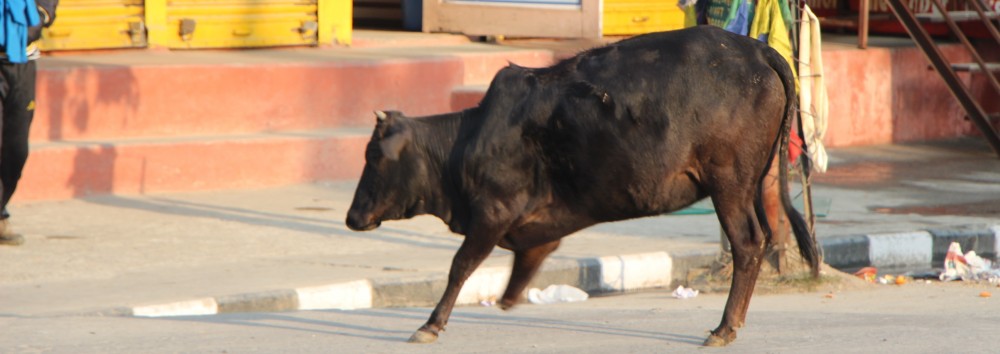
Bovine freedom

A three legged cow negotiates an early morning intersection in Pokhara

A three legged cow negotiates an early morning intersection in Pokhara

Bovine in Nepal will stand in the middle of busy intersections, in peak traffic, expressing their religious given power. I have witnessed peacefully sleeping herds as frenetic local buses and micros, filled to the hilt and beyond with humanity, navigate around their resting.They know space is made for them here, despite their cardboard and plastic eating ways. Cows and their ilk are the street cleaners of dis-guarded food and the plethora of street debris that accumulate after the early morning daily sweeps made by the ladies of the broom.

The ladies of the broom are a sight in themselves, if you awaken early enough. Groups of four or five women shrouded in yak wool scarves, armed with a short natural fiber broom, hunch over and systematically clear the dust and rubbish. They work in a practiced rhythm leaving a temporary order in their wake. An order that is quickly disturbed as the city awakens and the waste of this developing nation occupies the street once more.

I do not know how much these women earn for their daily labours but it cannot be much more than around 60 rupees per day. Labourers on building sites earn around this amount, for what I perceive to be back breaking work, carting building supplies in cane baskets, the weight held by the head. Life can be hard here but these people have a wage which many in villages do not. Especially if it has been a bad year and the monsoon rain came late or early leaving small yields or none at all in it’s wake.

Subsistence life is tenuous at best and even worse if you are one of  landless in Nepal flocking to Kathmandu to inhabit the banks of the Bagmati River. Life then is not tenuous, it is a dance from moment to moment. In some ways more space and respect is given to the holy beasts of the road then the landless here. For cows do not have to negotiate with the politics of caste, nor cope with the ever present threat of being moved on if land is ear marked for development or they are unwanted in an area. There is always space for holy animals, for people sometimes there is not.

I may be wrong about this, and please correct me if this is the case. I want to be wrong. These are the observations of an outsider and perhaps this correlation is incorrect and unfair.

That said I have read of Bandhas ( strikes) to protest the moving, by the Government, of landless communities in Kathmandu into a new area. I am yet to hear of a bovine bandha protesting the cows impeding traffic and smooth passage through the city or any area of this beguiling country.

Cows are holy, the landless are not.

Dancing with gender anger

I feel angry.

I feel angry that as a woman it appears that I have no choice but to be a feminist in order to protect and defend my right to be equal because by genetic chance I was born female. I feel angry that by having a womb, breasts, ovaries, a uterus, a cervix and a vagina that I have to interact with a subtle latent secondary set of cultural and societal rules in order to justify my innate right of equality.

I am human and from my perspective all humans are equal regardless of race, ethnicity, religion, sexuality or gender. So why is it then this humanness of mine is constantly challenged by statements such as “No doesn’t always mean no,” by US federal agencies such as FEMA and by some political parties wanting to legislate what I can and cannot do with my body?

Why do I have to read about men discussing how my body can shut down the reproductive process if I have experienced a “legitimate rape”? Why do terms such as “emergency rape”, “honest rape”, “enjoyable rape”, “forcible rape” and  “gift from god rape” even exist as terminology?

Why does it matter what I wear and why can I not walk home alone late at night, why is that even questioned? Why is it I get told to “calm down” when expressing a valid cohesive perspective in the work environment? (When a male colleague two minutes later says the same thing and nothing about his emotional state is mentioned.) Why is a male colleague allowed to say to a female co-worker “you are being emotional” when he would never say such a thing to a male colleague? Why is it okay to comment on my age, appearance and weight? Why does my appearance even matter? Why is it I have to justify feeling angry about having to ask if a “women asked for it” when reporting on a rape story for a national newspaper? Why is it when a women defends herself after constant and ongoing subtle sexist and misogynistic comments she is called “attacking” by mainstream media? Why is it that though I have more consumer power then men, I  still generally get paid less and have less representation in business and in government? Why is my strength and intellect a weapon used against me and why am I sometimes feared and termed as “ball busting” when a male would be called a “go getter” or “analytical and progressive”? Why is it a friend got asked if she had a husband when applying for a job and then told  that as she might get pregnant there was no job for her? Why are essential products needed because I menstruate highly taxed in some countries? Why does it cost more financially to be a woman than a man?

I could go on but it seems redundant.

And let me be clear. Because I feel angry about this doesn’t mean I hate men, I love men, some of the best and dearest people in my life are men. I hate the fact I even need to state that.

Why is it that if I am angry about gender injustice some will argue it is because I hate men?

Why is it if I feel angry about gender injustice my sexually is  sometimes questioned?  Why is it okay to call me a “Fucking feminist”, “Fucking dyke”, “fucking cunt“, as if those things would be an insult if they applied , if I dare question the status quo?

Until recently I didn’t refer to myself as a feminist as I equated it with too much anger but now I do feel angry.I am fed up with the latent under currents I deal with, the justifications and hoops I sometimes have to jump through because of my gender.

I don’t want to feel angry – I want equity. I want that universally for all women and men – we deserve balance.

I don’t want to deal with comments. I don’t want to have to prove anything, to have evidence.

I don’t want to be denied justice because the hassle of reporting an incident to the police is adversarial and traumatic.

I want to be happy.

I want to be good at my job just because I am good at my job. I want to walk home at one in the morning because that is when I chose to go home. I want to wear a tight skirt because I like it and it makes me feel good. I want to have lovers and not risk being called a slut.

I want to live my life the way I want and it not be a big deal I’m not married and don’t have children. I want to live my daily life and not deal with harassment.

I just want to be happy doing what I am doing and for no one to comment. It’s not a big deal. I’m just a woman- get over it.

Here I Am

I returned to Nepal late Monday evening after an epic 32 hours travelling  from Melbourne through Singapore and Delhi after a hectic few weeks  finishing up work,putting my life into boxes and selling off everything else. Since my arrival I have been feeling the upheaval that is intrinsic to selling up and relocating to another country. The things we do to follow our dreams…the emotional components of such a move cannot be underestimated. Suddenly I find myself exactly where I want to be, to do exactly what I want and the magnitude of it feels scary. Right but scary.

Therefore my first few days here have been slow, while my body recovers from the 3o plus odd hours of flying and transit, and while I emotionally get to grips with leaving behind the stability of conventional life in Australia. There have been some emotional moments, and while I mean to  predominantly write as a journalist and cover issues and stories I don’t feel my  personal experiences as part of some stories takes away from that premise.  I feel it adds to it. I am not a writer whom believes in the objective observer, in fact I vehemently deny it. What I experience and where I am adds to the fabric of the stories I will cover and what I discover here. But obviously alongside sound journalistic practice.

Journalistic objectivity rant over.

So here I am.

I arrived  from the airport to be greeted by my favourite Kathmandu dog, Baba, waiting in the alleyway for me. How did he know I would be arriving? But bloody lovely none the less.That wagging tail and bounding hello put such a smile on my face. Since Tuesday I have been drowning myself in sweet cups of dut chai ( milk tea) while scoffing veg momo’s with alarming amounts of achar ( pickle) between epic  naps and little wanders to meet up with friends and reconnect with this city I love.

The government’s road re-surfacing and widening campaign  – thanks to Chinese funds  – continues making certain parts of the city profoundly dusty with all my clothes taking on a shade which I am now calling infrastructure improvement brown. All the tourists this high season are wearing it so for once I am on point fashion wise. But the sky has been remarkably clear for this time of year and from my guesthouse rooftop I have sat and stared with barely contained glee as the moon rises over the Himalayas. A sight so beautiful it is hard to comprehend let alone express.

So yes, here I am. My life in Australia packed into one box,a bag and generously being looked after by friends back in Melbourne. And everything I need in a backpack.

I now carry my life….it is up to me.

Strike and you’re out

Today there is a bandh ( a general strike ) in the Lalitpur district to the south of Greater Kathmandu.Appointments have had to be cancelled and rescheduled twice over the last 24 hours as the bandh has been extended by another day and the people I was meeting are unable to leave the area. Anyone breaking bandh  can be dealt with severely – repercussions coming in the form of violence or other actions as deemed fit by supporters of whatever faction has declared the strike.

In bandh conditions all stores close, taxi’s cease to operate in affected areas ( as do private vehicles), tourist sites shut down and even hospitals can be closed – though those needing emergency care can sometimes get assistance if they manage to get an ambulance willing to break bandh conditions and those enforcing the strike to let them through. Curfews can also apply.

The current  bandh also effects the area’s of Pulchowk the home of the United Nations and a large number of INGO’s  and tourist attractions in Patan. The general strike has been declared to protest the re-settlement of  landless squatters from along the Bhagmati River to Sundarighat. Recently squatter tent homes along the Bhagmati River have been bulldozed by the government.

According to Nepal News;

 Normal life has been partially affected in Lalitpur district Sunday due to a shutdown enforced by enraged locals protesting against   the government’s plan to settle landless squatters at Sundarighat, Balkhu.
Demonstrators have enforced shutdowns in Lalitpur and clashing with the police since the past one month against the government plans to resettle the squatters evicted from encroached land in the Thapathali area at Sundarighat.

Arguing that settlement of evicted squatters in Sundarighat will have negative impact on its environment and tarnish its natural beauty, they have been demanding that the government shelve the settlement plan.

All shops and businesses in the main market center including educational institutions in Lalitpur remain closed since early morning today while both public and private vehicles stayed off the road due to fear of attacks by bandh organisers.

The government has started constructing 48 bamboo huts at Sundarighat for squatters who were evicted from Thapathali area two months ago to make way for an urban development project. Rs 2.2 million has already been released by the government for the purpose.

Private Higher Secondary Schools in the district also remained closed Sunday due to the bandh (strike) enforced by All Nepal National Independent Students Union- Revolutionary (ANNISU-R) demanding that foreign name of all private Higher secondary schools across the country should be replaced by Nepali one.

Bandh’s are particularly harmful to the local economy especially when prolonged and in the high season for tourism and volunteering. As it is Monsoon it is known as Volunteer season which deals with consistent but lower number of voluntourists. They also profoundly effect the ability to carry out the necessary functions of daily life in the developing nation such as access to food, services, medical care and clean water depending on location, season and availability. Freedom of movement  is also affected.

In the past bandh’s have been used to great effect by the Maoist movement. In 2009 the day before a general strike was called by the Maoist faction I witnessed 17 buses coming into Kathmandu from rural Nepal over a one hour period. It has been used as a mechanism to shut down huge swathes of Nepal until  political demands have been met by whatever party calls the strike.

In May the Far Western Region of Nepal was crippled by a 27 day bandh protesting the proposed division of Nepal provinces along ethnic lines as part of the new constitution. The constitution failed to be finalised  and currently Nepal is under a caretaker government with no confirmed election date.

Personally ,apart from the rescheduling of appointments and insane traffic  – as parts of the city’s transport system are unavailable- central Kathmandu at this stage is largely unaffected though that could change if the bandh becomes on-going or is extended across a larger part of the city.

But what to do, its Kathmandu, and bandh’s are part of life here.

I howl

It is midnight, I sit in my rooftop room overlooking the alleyway. I take a swig of Nepal Ice, ice-cold and a bargain at $1.30Au. Nepali and western voices interplay in their slow aural meanderings towards me. A dog howls, this refrain is picked up by Baba at the next house, there is a pause and another speaks in turn. The howl picks up in force and magnitude as others join their voices to the wailing. The sounds swirl around my little part of Kathmandu that I call home for this trip.

I had forgotten how much I adore this place.The chaos, if you choose to see it that way, makes sense. It is an honest representation of humanity without the contrivance of hiding away things in the lesser seen places.Things are observable -the struggle, the joy, the madness of modernity. The contrivance of the aid industry and the financial exploitation that can occur. The love of family and human connection, the luck intrinsic to a good life and the rawness of life in a country finding itself again after years of political and environmental instability.

Despite the country having  a caretaker government since May when the Constitutional Assembly failed in signing off a constitution for the fourth year in a row – Nepal functions. And as a representative from the UNV (United Nations Volunteers) said to me, even in the ongoing political instability with each Constitutional Assembly failure, that failure is less and less and some solid ground is being found.

Slowly , perhaps ungracefully, a foundation is being built for this developing nation. A foundation where the political gambling for power between the 209 political parties with a foothold in the government they appear to have less ability to unhinge it at the core leading to conflict on the streets.

This is not to say conflict does not occur. Recently after the May constitution failure, a 27 day general strike crippled a number of villages in the far western region of Nepal. Access to food, medical care and clean water was cut off and anyone acting to break the bandha (strike) was dealt with.

According to the acting government last year tourism figures increased by 20 per cent in the Himalayan nation. This growth is essential as tourism is a life blood of the Nepali economy alongside international aid money and  development  loans from the IMF/world bank. That said tourism cash does not touch all parts of this ethnically diverse country but it adds to the foundations firming despite  the geo-political maneuverings of China and India, which are predominantly helpful from an aid perspective,  but can have a destabilising effect.

For example, Nepal has an obligation to spend money received from China to develop roading infrastructure by a certain date each year to ensure on-going financial support for an essential infrastructure which needs development. Therefore Lazimpat, the embassy district of Kathmandu is in a small upheaval as buildings are cleared destroying homes and businesses to widen the road to ensure funds are spent and the coffers are refilled.

Nepal in many ways is the front line, the coal face, of interactions between the regions super powers. On reading the  English language papers the Himalayan Times, Kathmandu Post and the Nepali Times (among others) this coalface is clearly illustrated – when a Chinese government representative turns up within a few days a similarity ranked official will visit from India and vice versa.

Obviously my observations are simplistic representations of the complex reality of Nepal, one of the poorest nations in the greater Asia region, but they represent the slow changes taking place here. A here I feel privileged to visit often and love dearly.

Here comes the rain again

I breathe  in , deeply, I exhale slowly expelling the warm damp, that is the air pre the daily Monsoon downpour.

I am standing on a rooftop in Paknajol, an area  near Thamel the tourist hub of Kathmandu. Grey clouds are gathering and beginning to roll across the Kathmandu valley “hills” into the city. Large wet drops fall in slow motion cascades on myself and my rooftop companion with whom I have been discussing Middle Eastern politics to the tunes of Neil Young. (Doesn’t that just make sense.)

The cascades become a downpour and I stand arms stretched feeling the release from the humidity. Water runs in rivets down my skin- time to dash down the rickety metal spiral stairs to shelter and a nap to take the edge off the jet lag.

Jet lag does affect so much of the body, my jaw talks,water retention, digestion and sensation becomes very present for a few days after a flight but with massage, walking, local curd and yoga it passes.

Speaking of massage and yoga, near my guest house is an amazing natural medical center ( the name escapes me) that also runs yoga intensives.

This morning I had my first one on one yoga session to help my back and get my body back in sync with it’s new environment and oh boy do I know I have done a class right now. My class consisted of mainly twists, laying down yoga ( believe me that sounds deceptively easy but is not) and back bends. My teacher says I am not to do any forward bends for a week or so and I have back bend homework to do each morning and evening before our next session. I am looking forward to getting into the regular class in the next week or so even though it has a reputation for muscle soreness.

I am continually humbled being back in Kathmandu, friends from my last stay greet me as family and pour Chai in my direction. They are opening their homes,  contacts,businesses, NGO’s and restaurants open to me  and  Melbourne photographer Abigail Varney with whom I am working with here. I  get the feeling that this trip is going to be very productive professionally and I am loving it.

You can check out Abbi’s work at http://abigailloves.blogspot.com/

Abbi is a crackshot photographer and has been published in a number of magazines in Australia including Frankie and Yen.

Chai lag

Six hours into Kathmandu and I am already stunned by the synchronicity. I am also jet-lagged and Chai bloated adding to the wonderment that is post flight water retention. As uncle ( the owner of a guesthouse I stayed at on my last trip here) said “have you got fat?”, no, “Uncle it’s just Nepal you are all small here.”

Weight  comments aside I have been quietly embraced again by Kathmandu. A gentle embrace.

Walking from my guesthouse, Family Peace House managed by the lovely Bimal, I was greeted as a lost family member by people I used to see walking out and about the city in 2010.  Walking past a little store that sells samosas I was greeted with such smiles, and another store owner pulled me and drowned me in glasses of  sweet milky Chai, promptly followed by more Chai the next store down and another on my walk back home from a coffee hit at a local haunt for NGO types, volunteers, travellers and those needing a solid wifi connection.

Speaking of coffee, I need more.

Travelling is filled with such joys but lack of sleep, though it can make working your international adapters interesting, is not one of them. Everything feels vaguely surreal, familiar, unfamiliar…horn beepingly present and disconnected in this state. But I am here and interesting stories are already revealing themselves.

Ahhh….Kathmandu.