Dancing with gender anger II – the audacity of women who dare to speak up to gender inequity

A few months ago I wrote a piece here about my growing frustration at rape terminology  being used as part of the American election campaign. The piece also touched on the general slippage occurring around gender issues. Or perhaps in a more nuanced explanation, how there seems to be a reluctance to engage with the gender issues that still remain in our society and culture.

This reluctance ranges from dismissal or that old classic in gender debates; a twisting of everything to make those speaking out about discrimination etc dance to prove the negative. And when you do, this is dismissed or an excuse is found not to engage with the evidence presented.  When these people are challenged to prove gender equality, equal representation, the twisting becomes more profound and in many occasions the debate then becomes personal.

A few days ago I posted Clementine Ford’s  International Women’s Day article Are Women’s Voices being Gagged to a New Zealand journalism Facebook forum Kiwi Journalist’s Association (KJA).

Essentially Ford argues the following;

 “If the media is a portal through which we see the world, how does the conspicuous  absence of women and their voices skew how people experience the world around them? Across the board, the facts show that women are significantly absent from that mirror the media reflects back onto society. Women operating in the public space are constantly reminded that their presence is a privilege, not a right – and that privilege can be taken away any time they break the rules.”

My reason for posting an Australian Fairfax created article in an NZ journalism forum was two-fold. One, the NZ media does not work in blessed isolation despite some of the protestations of those who objected to the article ( Fairfax owns a large percentage of the NZ media market), it’s posting and my defense of it. Secondly, the content of Ford’s piece is indicative of some of my experiences working in NZ media until I left the country in 2010 and I strongly believe illustrates the boy’s club type structure the media generally speaking operates from.

To clarify, my posting of the article wasn’t denying progress around gender issues but it was a statement that there are still considerable issues around gender  that the media industry in NZ has an obligation to address.

In some ways a majority of the reaction to my posting of the story is indicative of what I feel is the boy’s club mentality in action. That I should be grateful for what I have and to raise my head above the parapet and question the status quo isn’t the done thing. I am aware of the ramifications of speaking out and continuing to do so. There is an implicit risk to  speaking on gender issues; I will be labelled as difficult and I feel there are possible career implications.

In the discussion I was constantly asked to prove the inequality, which I along with a few other brave women journalists did. These studies were predominantly international and therefore were declared invalid by those protesting against Ford and our support of her argument. When NZ studies were produced these were also largely dismissed and then the statistics of the Massey University study were used as a justification for why there would not be parity and gender equally in NZ media for about 30 years ” because of the statistics.” When I asked, repeatedly for evidence of the gender equity and pay parity in NZ media none was offered and, in what I feel was a rather patronising tone, I was told I didn’t understand the argument.

I would like to post the thread in its entirety here but the KJA Facebook group is closed and by invitation only. Out of respect for my colleagues and the group  I will not post screeshots nor I will identify those who were particularly unhappy with my call for proof of equity in the NZ media industry. That said the administrators ironically proved Ford’s argument by closing the thread and “gagged” the female voices speaking out with evidence and experiential knowledge of how the NZ media can work for women.

I admit I hold KJA in far lesser regard due to the exchanges that took place in the forum and their lack of framework around gender issues that daily effect a large number of their membership. It also, from my perspective, speaks to the state of the industry that very few women spoke out about their concerns in an open forum and some male journalists felt free to behave in an unprofessional and sometimes bullying manner.

A number of women did contact me privately  and thanked me for speaking up and for confirming that they weren’t “going insane”. To those women, thank you for your support, it was an unpleasant run in which ultimately proved Ford right – I am appreciative of that. The article is not as one person stated “facts obscured by emotive, partisan twaddle.”

Here are some further links speaking to the  issues and general position of women in media. Please note all of these links were used  in the KJA discussion thread.

http://www.theaustralian.com.au/media/for-women-newsroom-remains-a-battleground/story-e6frg996-1226563067616

http://www.knightfoundation.org/grants/20120284/

http://changetheratio.tumblr.com/

http://www.scoop.co.nz/stories/BU1112/S00093/women-journalists-flee-newspaper-careers.htm

http://www.guardian.co.uk/lifeandstyle/the-womens-blog-with-jane-martinson/2012/oct/15/shocking-dearth-of-women-in-journalism

http://journalistcomplaints.com/article/2012/07/meaa-needs-act-gender-bias-newsrooms

http://www.theaustralian.com.au/media/how-women-journos-stake-place/story-e6frg996-1225713076068

http://mro.massey.ac.nz/handle/10179/2780

Occupy Melbourne -Day 1.

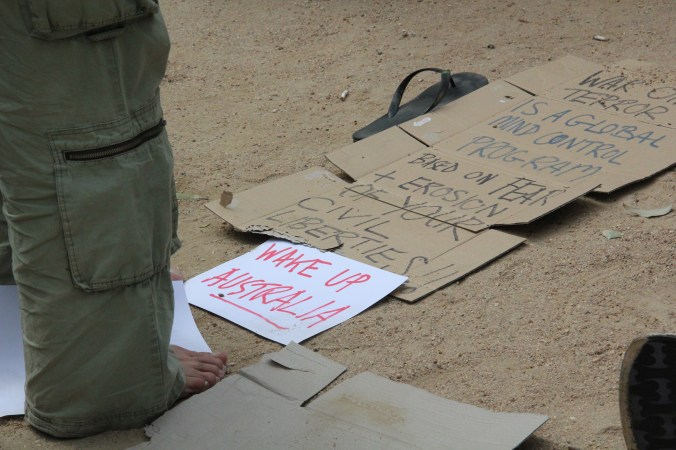
There is something magical about walking into a publicly held space, a space being  reclaimed for change. City Square in central Melbourne occupied  peacefully despite the four mounted police of the occupation, despite police cameras filming the crowd from above and a crowd representing a diverse range of political opinions.It is inspirational.

Poets, punks, anarchist dogs (“no leads, no leaders!”), children, environmentalists,performance artists,film makers, hipsters, unionists, curious teenagers joggled alongside one another, took to the mic, workshopped, assisted organisers, played drums and marched in support of others (BDS protestors) who had previously arranged a march. It became more and more obvious as the day continued that peacefully and together we have real power. Even though in Melbourne they are only just picking up the reins started with the Madrid Occupation that started in May, it feels like this movement has the potential to facilitate change. No other reason for all the police, surveillance and undercover cops in the crowd unless the occupation movement was a real challenge to the inequitable status of now.

One of the criticisms of the #occupy movement is that it doesn’t have concrete aims. But from what I see internationally not having concrete aims at this early stage of the movement is the point. Huge sections of the population globally are dissatisfied with the status quo. With the insane inequality of wealth distribution , a correlating power resting in the hands of the very few and governments globally facilitating this concentration of power (As one occupier said to me yesterday. “Governments no longer govern, they are corporate administrators”) to have a cohesive plan already laid out would be unrealistic and non representational of the diversity of the movement. The movement needs to be representational, grassroots based so it cannot be co-opted to represent current government/corporate interests. This is something I found evident yesterday, the general assembly model while slow-moving means that strategies developed are truly representational of the majority.

It became clear  after speaking to more people than I can count that not only do occupiers want the world to be equitable,they want real community , they want purpose and meaning, they are claiming back our connectedness. Occupation is about putting humanity first.

A sign of the times - #occupymelbourne day 1. Copyright Alexandra Bremner 2011

Nepal and Northern India Earthquake

An earthquake  struck Nepal and Northern India at 6.10 pm local time on Sunday, September 18.  Indian English language News X service is reporting that the 6.8 quake hit the region causing significant damage, waves up local rivers and casualties. Associated Press footage from Nepal shows a number of dead at a Kathmandu hospital, the crumbled wall of the UK embassy and people out in the streets post quake. (Please note in the link provided there is footage that may disturb some people.)

The Kathmandu Post is reporting landslides and seven deaths from one landslide alone in the Rolpa district. (* please note this landslide occurred the day before the quake, my apologies for any misunderstanding) The Guardian is reporting 16 confirmed deaths and damage to buildings.

Infrastructure and building codes are variable in Nepal so the potential for more fatalities and damage to needed services is high. The steep mountainous terrain means there is a potential risk for more landslides.

If anyone has any additional information on what is happening within Nepal please let me know. You can email me at neesha@storytellerproductions.net

To all my friends in Nepal, be safe!

No Xie Xie

Before I begin sharing my impressions and personal experiences of living in Taiwan I want to caveat what I am writing about.  While I was in Taiwan an article was printed in a Montreal paper that shared a negative experience of living on the island nation.  The writer of said article was hailed in a storm of negative feedback, some of it attacking and from my perspective pretty nasty. My intent here is not to demean Taiwan or its expat community but to share my experiences. A lot of what I experienced was challenging and not what I’d call positive. I understand for many people Taiwan is the making of them, they love it and this is how it is for many of the people I shared time with. To my Taiwanese friends please do not take my impressions personally, it isn’t about you, it’s about my experience of Taiwan. If Taiwan is your place of bliss I salute you. It’s a tough place.


I was given three key pieces of advice during my time in Taiwan.

1) Drink more.

2) Get busy so I wouldn’t have to feel so much of what my life is.

3) If I want to meet someone to share my life with or get laid becoming a lesbian would be my best option.

Obviously this advice was given to me in more nuanced terms, and garnered from a number of conversations, but the above are the essentialist gems I received on how to survive/ live in Taiwan as a woman in my thirties.

Let me get clear from the get go on this. I’m not a huge clubber or bar-hopper. I’m more a dinner with friends, cook, discuss politics, poetry, art, life, listen to and play wonderful music kind of woman. In my life I have never had the desire to equate a good life with being busy. Being busy for the sake of it I see no purpose in. It feels like escapism, as does excessive drug and alcohol use. And becoming a lesbian, as a pragmatic choice to get laid doesn’t appeal though that said my philosophy is you love who you love.  Welcome to Taiwan.


I arrived in Taiwan on January 17, it was late in the evening, I was blissed out post a lovely three weeks spent fasting, doing yoga and hanging out with beautiful people and   dear friends in Thailand. Tobie Openshaw, my friend and documentary and video production mentor, was at the Taoyuan airport to pick me up and the whirlwind began. A longer than expected trip into the city to meet another friend who was kindly putting me up and subletting their room to me while I got myself established, was followed by discussions about local politics and conditions for remittance workers, then dinner and drinks.

My notebooks and photographs of the time have a distance to them that isn’t typical of my style. It is like I stepped outside of myself the moment I arrived on Taiwanese soil. After a few weeks I stopped writing altogether, with the exception of three pieces, and have only just started again. Six months is a long time not to write for me.

An introduction; a thousand words, sounds and images flickering, bright, but black to grey.”

The first few weeks were spent adjusting into Taipei, getting a bike (essential for Taipei city living), catching up with friends based in Taiwan I had met elsewhere, signing up with a teaching recruitment agency, joining a yoga studio, a women’s circle and hunting for a place to live. I found an apartment, sans kitchen, and a teaching job within three weeks. Not bad going really but everything I was doing felt pushed and unnatural, the flow wasn’t there.

My apartment was in Gongguan, a university suburb of Taipei, which is bubbling with student life, a night market and 10,000 people per square kilometre according to some statistics I found online at the time. I had to move into one small apartment and then ten days later move out, spend the night with a friend and then the next day move into the larger apartment, still without a kitchen. I was about to discover that small “inconveniences” or extra steps like this were to become part of my daily routine.

Teaching English as a second language was never something I aspired to do. But in order to stay in Taiwan, cover my costs and do my internship with Bignose Productions I needed both the income stream and the residency visa a teaching job would provide.

I signed up with ACI a teaching agency and got a job in Sanxing near  Taipei 101 tower. My position was teaching K1’s (18mts to 4 years old) English through language immersion. Technically I was working illegally though I had a visa as a cram school teacher. Language kindergartens are illegal in Taiwan. My school fudged my visa application in order to hire me. This is pretty common practice. What is also ‘normal’ is fines for being late, fines for illness and not finding a replacement teacher, fines for sloppy dressing, fines for breaking your contract – it cost me around $ 1000 NZ to buy myself out of my contract – admittedly my school was hard core in this regard, but not exceptional.

What may have been different about my pre school English teaching environment was the level of pressure put on the students. My babies, and they were lovely, aged from 18 months to four, had three text books and three workbooks and I had to teach around forty pages of new vocabulary and concepts per month from just one of these text books. The level of comprehension was obviously different for the students who couldn’t speak Mandarin yet but there were huge expectations none the less. I found working in this environment incredibly stressful. I could see that for many of my students their childhood ended when they came to kindergarten. From that moment on, they would be subjected to regular testing and would have to do well  and in the right way to meet the cultural expectations of Taiwanese society.

I taught for three to five hours a day and tried to make it as fun as possible while meeting the syllabus requirements. I made rollie pollies a physical response learning method to learn shapes and counting, I called story-time listening comprehension and singing became drilling/ rota learning, which my school was a huge fan of. Despite this there was a fear in my school. One little boy would vomit when he arrived at school each morning. And quite frankly I don’t blame him. When a student was told off by a Chinese teacher they were shouted at and made to stand on an A4 piece of paper with their hands over their head for up to 45 minutes. To do that to a three year old is beyond my comprehension and it began to sicken me. I literally began to feel ill and drained by mediating the environment as much as I could while meeting everyone’s expectations.

There are some that could validly argue that I should have left and changed schools but at the time I was in the middle of the visa process, I was trying to get settled, establish routine etc. And to be perfectly honest I felt compelled to make it work. I didn’t want to fail. I wanted to teach to pay my bills and then spend the rest of my time filming, learning production from Tobie and putting a documentary I envisioned together.

But despite significant progress being made in pre –production and getting some great experience under my belt I was feeling more and more drained. Aside from teaching, trying to connect socially was hard for me. I was cycling daily, doing yoga when I could, going to workshops and meeting a few great people but I wasn’t gelling. Part of this was my reluctance to go to clubs when I knew a lot of K or Ketamine (the predominant drug of choice) was floating around and that what I would call heavy drinking was integral to some circles I brushed with. I don’t  generally like being around drugs or excessive drinking.

I feel I have to be very delicate talking about this aspect of Taiwan expat life as many of the people I met took drugs and got drunk on a regular basis. For me that kind of lifestyle is escapism and many of the people I met living that way from my perspective did not seem content.  In fact they seemed unhappy, were searching for things in Taiwan they couldn’t possibly find and the drugs and drink were a coping mechanism. Many of the women I met talked about being sexually invisible in Taiwan and I could see the truth of that during my time there. Of course as in all things there are exceptions to this generalisation. But from personal experience and the conversations I had in researching  for a documentary on what it was to be a western woman living in Taiwan the observation holds.

It was during these conversations lesbianism as a pragmatic choice for a relationship was mentioned.  I brought this up among other friends and this perspective was agreed with as an “easier” option.  It does seem surreal that in order to met a rather fundamental human need of companionship and physical connection changing sexual orientation was deemed a viable solution in the cultural environment of Taiwan.

Daily  life became  a struggle for me pretty early on. With dietary limitations I found food an ordeal, especially without a kitchen. I had experiences of ordering food and being totally ignored. It became a grind and eventually I gave up -living off night-market food and out of seven eleven. The language barrier also became increasing difficult though I tried to engage. I had a couple of bike accidents, one with my faced smashed against the pavement, stars swirling before my eyes. People stopped and stared but no help was offered. I was told that this was due to wanting keep face and also avoiding being sued. Which is crazy as my bike slipped on road marking paint slamming me into the curb then along the pavement. No one’s fault, it was just one of those things. A rather unfriendly, not necessarily pro foreigner doorman sent an important parcel back to the post office. It took days and finally in utter frustration me bursting into tears and being rescued by a lovely woman called Cole before the parcel was found and just before it was about to be sent back to New Zealand. My visa was a similar experience with a few extra hoops having to be jumped through and money paid out, as my school had not applied for all the paper work I needed to stay. I do have to say the Taiwanese health system in regards to getting visa is damn efficient.

At this point I was at the end of my tether, I was crying everyday, sleeping as much as I could so I didn’t have to engage with the shear force of humanity out my door. I have never felt so overwhelmed by a country before in my life. I did confide in people, say I am struggling but I’m not sure I was completely honest with them or myself with how hard I was finding it.

In writing this I am totally exposing myself to criticism and I accept that. But to those people I say I did my best. And I will say to anyone, definitely visit Taiwan there is some amazing dynamic stuff happening and some amazing people . But seriously consider what you want your life to be before choosing to live there.  I thought by having a few friends in country some of the adjustment to living there would be mediated but I was wrong. I thought having had lived and travelled a fair amount it would be a similar experience. I was wrong. I am not hard enough to live in a culture like Taiwan’s nor do I have the ability to escape myself through business or alcohol and drugs. I failed at Taiwan, even after trying for four months. I failed and I’m okay with that.

I would like to give special thanks to Lesley, Angela, Prish, Tasha, Leonie and Tobie. Without you I wouldn’t have gotten through. I will always appreciate what you did for me. And to my other friends who helped me out and I shared a laugh with thank you.
Nepali journalists still targeted in Nepal

“Both sides of the  (Nepali civil war) conflict committed abuses against press freedom during the civil war but promised to respect freedom of expression after the peace agreement. Yet many atrocities committed during the war remain un-investigated, and attacks on journalists continue with impunity.”

 The  Committee to Protect Journalists latest report, following the murder of Nepal FM journalist Shah in the central Bara District and subsequent trail, illustrates journalist safety is an ongoing concern in the Himalayan nation. With the  constitution negotiations coming to a head and other political uncertainties it is important journalists working in Nepal can work safely. The country is walking a tightrope and critical, in-depth journalism is essential to a good out come for the population not just Maoist insiders and other invested parties.

The Traffic Tango

Get on your bike, take a deep breath, pedal and as a good friend of mine said on my first bike ride in Taipei, “don’t look back, never look back.” She is right.

Traffic here in Taipei is a chaotic dance, a tango for those in the know, but for the uninitiated oh man is it a baptism of flying taxi’s and screeching brakes.

First off, a red light doesn’t appear to always mean stop, it may mean go faster, duck and dive past that bus, quickly quickly!! (I’m not sure yet going on evidential proof).Secondly, a pedestrian crossing is not necessarily a safe place to cross the road, be you a cyclist or pedestrian. And near a free turn corner -KEEP YOUR EYES PEELED – or you may end up as someone’s hood ornament. It is not that Taiwanese drivers don’t care about driving safely it is just there is this highly competitive edge to outdo one another, to be the best  by beating the light changes from red to green and vice versa. It is a small daily achievement that assuages the Taiwanese ego. “I bet that bus through the lights, HUZZAH” – well not huzzah obviously  but something similar in Mandarin.

As a new cyclist, I love my bike “Dolly”, she’s gray, a bit shiny and has a basket – a very useful implement – which carries everything from my shopping to school gear but not as I found out yesterday a clothes drying rack. (Yes,that may have been an optimism to far.) But Dolly unfortunately is not the most agile of creatures, she has lacksidazical steering and temperamental brakes which on a wet surface a couple of weeks ago lead to a rather spectacular sideways flying head  and ribs crashing against pavement experience.

This experience apart from being painful for a week or so was interesting culturally. I lay stunned on the pavement for a good five to ten minutes  in shock, pain and a with a serious case of shakes and not one person stopped to offer assistance. Scores of scooters passed me, and drivers stopped and stared in the peak hour traffic but I was left to my own devices. Friends here have suggested people didn’t want to  help as they were worried about being sued or knew they couldn’t speak English to me so kept on driving. I’m not sure what it is and luckily I wasn’t badly injured but watching scooter after scooter by the dozen and car after car drive by when I was having a good ole cry and obviously in distress was far more disturbing than the unexpected pavement greeting.

I don’t have a good feeling about this aspect of Taiwanese culture, what happens to a foreigner that is seriously hurt? Since I’ve been here one foreigner was killed in a hit and run with a taxi and another was found near a flight of stairs and now his family is fundraising to pay for his  on-going care.

To counter point this darker aspect, it must be said I have met some wonderful Taiwanese who I am sure would help anyone they saw in need.

I do love my daily bike to and from work though.  Dolly and I leave home about 7.30am and then pedal our way through the university campus and down what can be a frighteningly busy Keelung Road. Half way to my school I stop, get a coffee, and sit and read my book for a good half an hour or so before going to teach my class of little ones.

A local hotel doorman always yells “good morning” to me, the Big Issue guy waves and smiles, the lotus blossom seller always gives me extra blossoms (they make my apartment smell delicious) as I furiously ring my bike bell and avoid hitting pedestrians. (People in iPod bubbles are a problem!)

I am grateful for my bike and my daily cycle of 16 km or so, though the pollution can be full on and the traffic confronting physically and culturally, exercise is helping me stay centered in a country I find  tough going.

Image and text copyright Alexandra (Neesha) Bremner 2011.